Reddit Is Read Without Being Visited
Product case studyReddit’s content is consumed without a visit. The visit is the part Reddit is paid for.
Reddit Is Read Without Being Visited
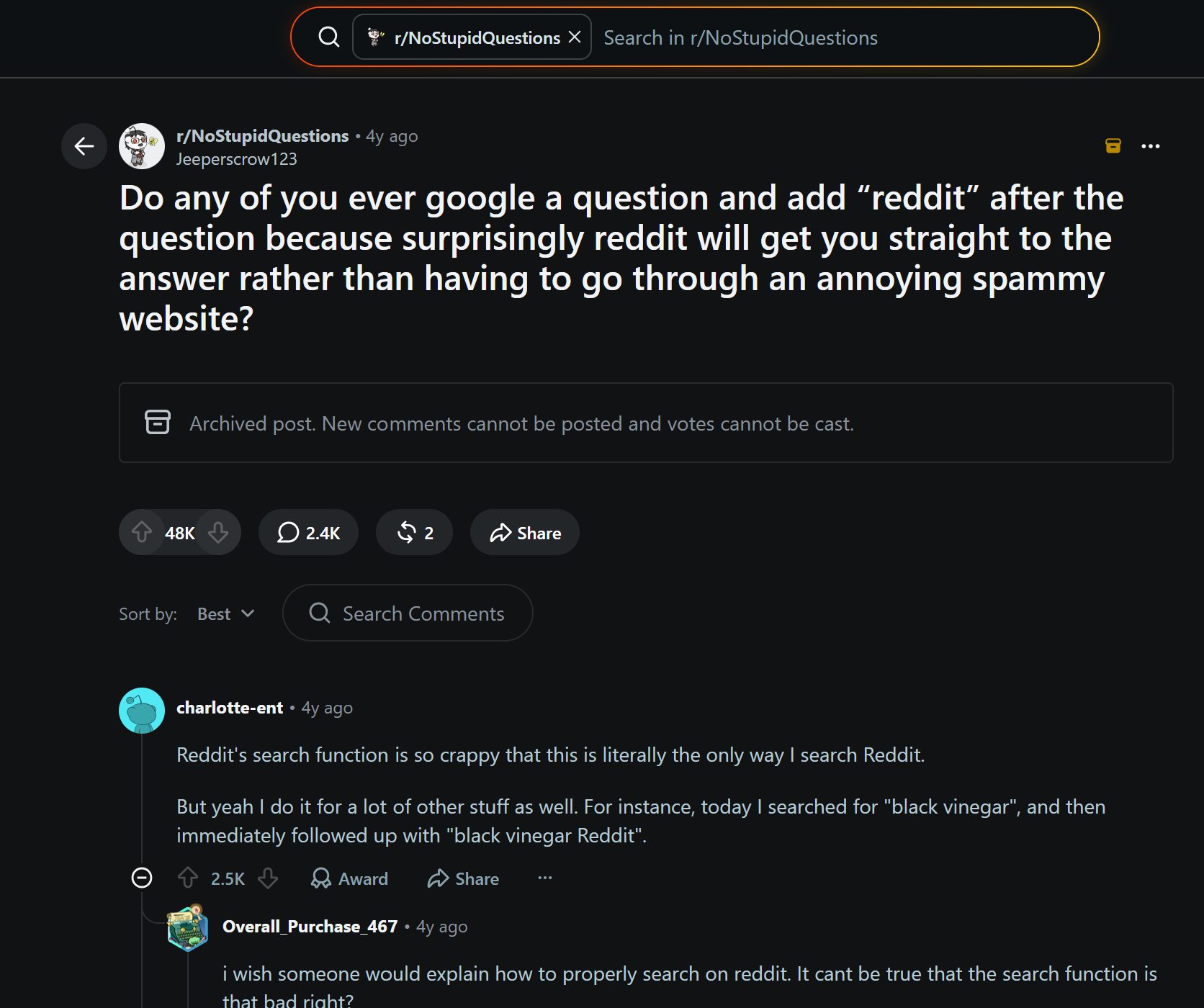
Search a bug, a product, a symptom, and you'll append one word to get a straight answer: reddit. You're not alone. An entire 48K-upvote thread exists of people describing the habit, unprompted, because Reddit's own search is worse than routing through Google to reach it.
I first wrote this case study about that habit. The problem then was a user who arrived, got their answer, and left. The harder version arrived since: a user who never arrives at all.
Ahrefs studied 1.4 million ChatGPT prompts and found the model had pulled 16.18 million Reddit pages and credited 1.93% of them. Two thirds of every URL ChatGPT retrieves and does not cite belongs to Reddit. The content is being read. The visit is the part that stopped. And the visit is the only part Reddit is paid for.
Reddit Earns from One Audience and Is Increasingly Made of the Other
Reddit had its best financial quarter and its worst distribution quarter at the same time. On its own filings, revenue was $805 million, up 61%, an eighth straight quarter above 60%. Advertising was $762 million of that.
Underneath it, the split. 77.7 million daily actives are logged out, growing 27%. 52.6 million are logged in, growing 7%. The logged-out user lands from search, reads one thread and leaves. No account means no repeat-visit signal, no retention curve, and no lifetime value to price an ad against. The cohort that pays for the business is growing four times slower than the cohort that cannot be billed.
The market noticed. Reddit beat on revenue, on daily actives and on guidance, and the stock fell 11 to 12% on one word from the CEO about referral traffic being “choppy.”
The Channel Is Squeezed at Both Ends
About 60% of Reddit's daily actives arrive logged out, and search is how most of them get there. Two separate things are now compressing that channel.
- Google answers inside the results page. On SparkToro's reading of Similarweb clickstream data, 68.01% of US Google searches ended without a click in the first four months of 2026, up from 60.45% in 2024. That is the steepest two-year move since the measurement began. Only 276 of every 1,000 searches now reach the open web at all.
- AI assistants read the thread and answer without citing it. The content gets consumed, the attribution disappears, and no session comes back.
Neither of these is Reddit-specific, which is the point. Over the year to June 2026, USA Today lost nearly half its organic Google traffic and Politico lost 23%. Every publisher standing on this channel is exposed. Reddit is just unusually dependent on it.
Where the Funnel Leaks
Follow a would-be member from search to churn, and each stage is roughly an order of magnitude smaller than the one before it. The pattern below is drawn from five interviews and a fifteen-person survey, read against the thread above:
- Acquisition. Lands on a thread from Google and gets the answer. Nothing on the page asks for a signup, so she reads and leaves satisfied.
- Activation. The rare visitor who tries to post trips Automod. About a fifth of Reddit posts are removed, and in a study of 907 users whose post had just been removed, 37% did not understand why.
- Retention. The removal has no soft landing. She reads it as rejection and does not try again.
The last stage of that funnel is one nobody measures at all: whether a first post ever gets a reply. That gap matters, and I come back to it.
The Fixes, and Why the Order Changed
Three fixes, each answering one leak. The order is different from the version I first wrote, and the reordering is the argument:
- Composer coach (now primary → Activation). Catch the doomed first post before Automod does. A real-time check inside the composer for accounts under seven days old, flagging flair, length, formatting and tone before submit. Baseline is a non-LLM rules linter; a model tone check gets added only where it earns its ~$0.001-per-check cost.
- Megathread fallback (→ Retention). When the coach sees a post that will fail, it offers the subreddit's megathread instead, in a sheet over the thread rather than a block. Somewhere to land. It sits inside the coach flow, so it never becomes a standalone “kids table.”
- Thread-page onboarding strip (→ Acquisition). A slim, non-modal strip replacing the app-install wall that currently covers the answer and that Google penalises. Community identity, an age-robust liveness count, one non-coercive call to action.
The composer moved to the front because it acts on supply, not arrivals. Arrivals are shrinking for reasons Reddit does not control. The posts are what survives the channel, and they are also the asset Reddit licenses to Google and OpenAI. That licence is renegotiated in the first half of 2027, so the health of the corpus is the negotiating position.
The strip is still worth shipping, and it is still the cheapest thing to test. But it protects yield on a falling channel. It does not drive growth, and this case study forecasts no lift from it.
How You'd Know It Worked
North star metric: new user activation rate, the share completing one meaningful action within 48 hours of signup, chained for this cohort as thread-arrival to signup to first action. Reporting only the endpoint under-credits a fix whose whole premise is that the valuable population never signs up.
The guardrail that leads: measure against concurrent holdout subreddits, not a year-on-year baseline. Referral traffic is now volatile for reasons that have nothing to do with anything Reddit ships, and a YoY comparison cannot separate a treatment effect from a Google core update. Thread indexability stays at 100%. Bounce rate is the wrong instrument here, because a search-arrived single-thread session counts as a bounce by definition.
And one I would flag against my own work: a megathread comment can move the north star metric while delivering the user nothing, because most get no reply. So the counter-metric is the reply-received rate on a first post within 48 hours.
What I'm Not Solving
All three fixes act on people who reach the page. None of them act on the person who never arrives. That gap is real, so here it is rather than a fourth feature I could not evidence.
The only surface a non-visitor ever touches is what the crawler sees. Any genuine fix has to change what Reddit exposes to be summarised. But that is a licensing and distribution decision before it is a product one, and the Google contract expires in the first half of 2027 with Reddit reportedly wanting usage-based terms. That negotiation sets the terms, not a feature.
What would change my mind is a single fact: whether retrieval fell or only citation fell. Reddit's share of ChatGPT citations dropped 86% in four days in August. But Ahrefs measured the same platform over the same window four times higher, the firm reporting the drop calls its own figure provisional, and a near-identical collapse in June recovered within two months. If retrieval fell rather than citation, this whole thesis inverts.
Licensing is not the escape hatch either. It earned $39 million last quarter against $762 million from advertising. Double it and it still would not cover a falling ad line. The visit is what pays, which is why the product work is still the work.