One Trip at a Time
Product case studyOn CREW, Swiggy's travel concierge.

The Product: What CREW Does That Almost No One Does
You have fifty-five minutes to catch your connecting flight, in an airport you have never been to, and it leaves from a different terminal.
You did not have to find that out. You were told before you landed, along with which train to take and how long it runs.
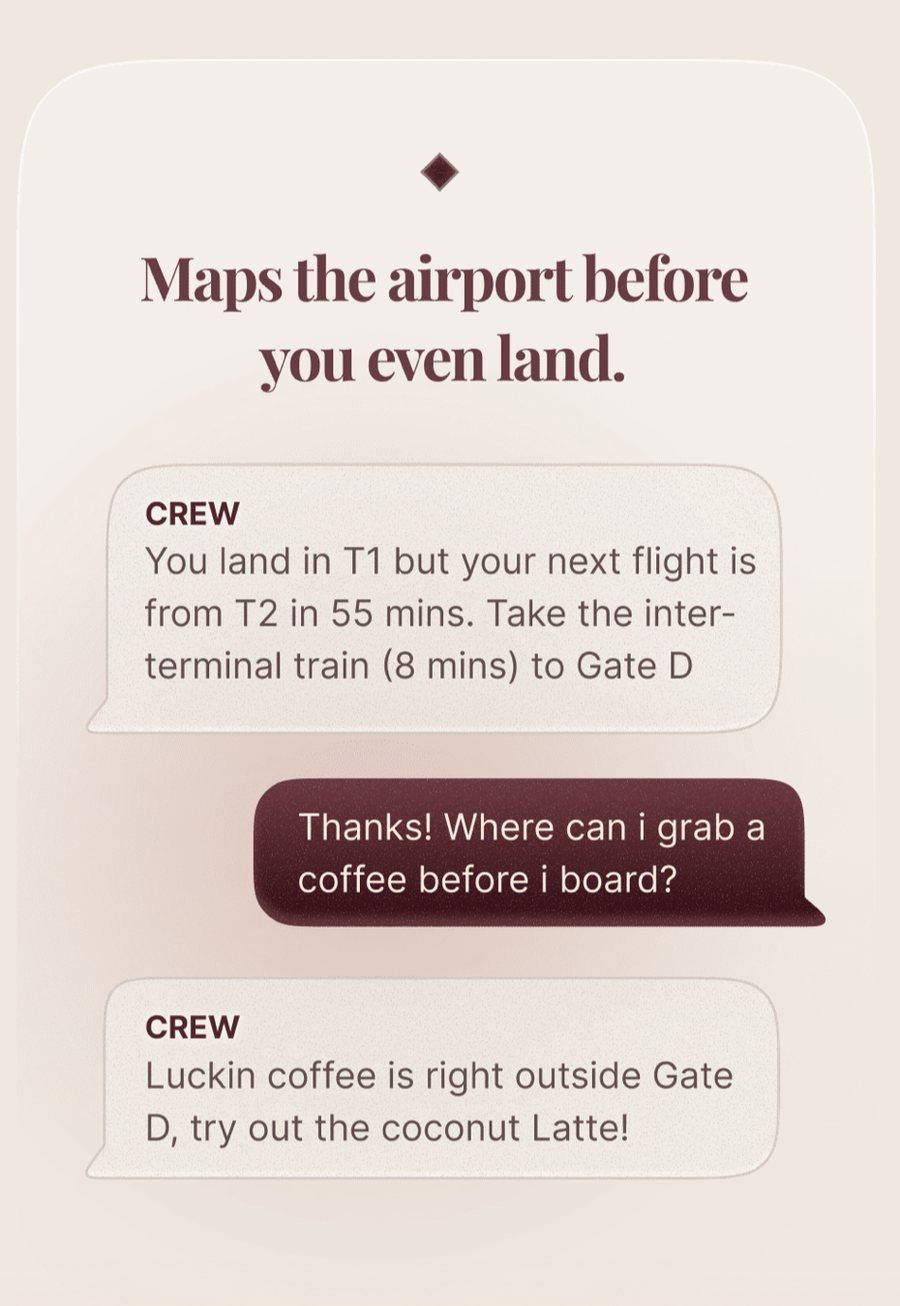
Nobody asked for that.
Any travel app can sell you the flight. Almost none will tell you about a terminal you have not reached yet. It is not because nobody else thought of it.
The Customer: Who It Is For
CREW says who it is for: affluent urban consumers who have money but no time. The second half is the real definition, and it is not about wealth. In the exchanges CREW publishes, nobody asks the price — a recommendation arrives and the answer is book it. This is not for somebody pricing one trip across five tabs. It is for somebody who has decided that choosing is the expensive part.
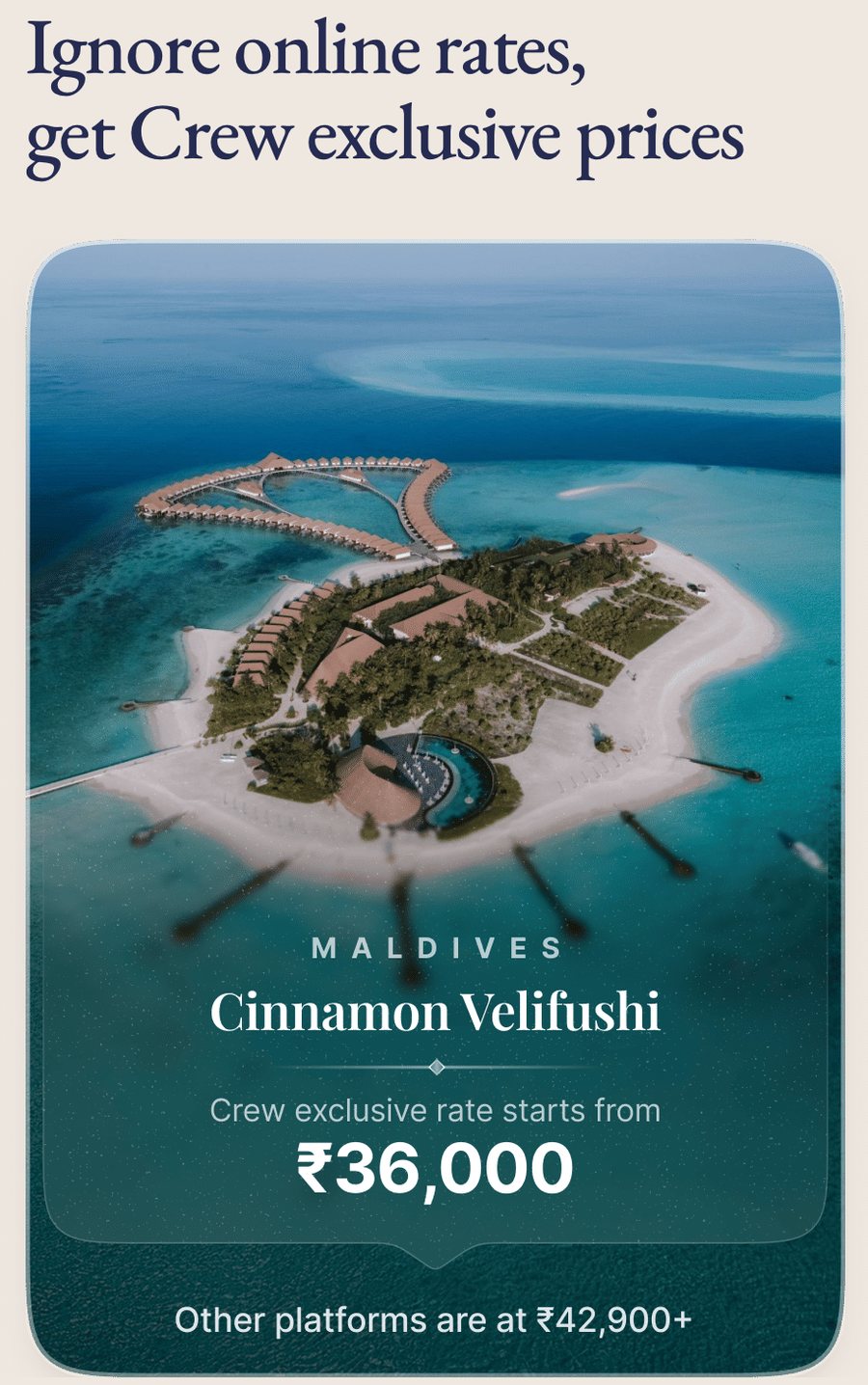
Worth most to the first long-haul. Expertise does not travel with you. Someone who knows Bengaluru street by street lands in Lisbon knowing nothing, and one wrong call on a holiday a year in the planning is not recoverable.
Worth least to the thirtieth flight. By then you know where the lounge is and you have your own visa routine, hotel and seat. For that traveller CREW is a nicer booking engine — which is exactly the product whose price you check.
The Moat: Why a Competitor Cannot Copy It
The reason is not the data.
To send that airport message you need the flight number, the connecting flight, and both terminals. Every large booking platform holds all of it, for far more travellers.
Plenty of them send alerts. An airline app will tell you its own gate moved. What none of them sends is the next sentence: your connection is on another carrier, from another terminal, and here is the train that gets you there in eight minutes. They message about a flight. Nobody messages about the trip.
Three things have to be true at the same time.
- You need the trip.
- You need people who will stay with a customer through a day.
- You need a relationship worth spending an hour of a person’s time on.
A booking platform has the first and cannot afford the second: a service team breaks a business built on volume. A travel agent has the second without live data. A general-purpose assistant has your boarding pass in your inbox and a lock screen to speak from, and nobody answerable when the plan breaks.
The Economics: Why Concierges End Up Inside Something Else
A concierge on its own carries three costs at once. The ones before CREW ran aground on the first two, long before the third mattered.
- Winning the customer. Customer acquisition cost is what it takes to win one — here, finding people who travel expensively and will hand a holiday over, one at a time. The purchase is rare, so the money takes a long time to come back.
- Keeping them. Somebody travels a few times a year, and a relationship that goes quiet for five months has to be rebuilt.
That is what happened to them. Ten Lifestyle ended up inside private banks and Velocity Black inside Capital One. American Express never sold its concierge separately at all.
CREW inherits an answer to both, and not because it is cleverer. Swiggy paid to acquire these customers years ago over food and groceries, and knows from its order history who spends. The relationship that stays warm is Swiggy’s, not CREW’s: Instamart and Dineout keep the customer in its life every week, travelling or not. So when CREW invites them, it is not a stranger writing.
The third is different. Cost to serve is the human minutes one trip consumes. Sitting inside Swiggy does not change this one. It grows with the number of trips, not with the size of the company.
And what comes in. One line is confirmed: the ₹999 the app asks for up front, which buys six months. Skift reports the subscription is not the only revenue, and CREW charges no convenience fee on flights, so the rest is presumably a share of what gets booked, taken from the supplier.
That leaves one number. Contribution margin is a trip’s revenue minus the cost of serving it, and since acquisition and retention were paid elsewhere, the human minutes are nearly all of that cost.
Everything below attacks the one cost CREW still has to solve for itself.
Distribution: How It Reaches People Without Going Mass
Order food on Swiggy and, while the timer runs, a card appears offering six months of CREW and ₹1,000 off a first hotel. Tap it and you leave for a different app, a different brand and a membership to activate.
Swiggy will sell you CREW. CREW does not live there. Instamart and Dineout became tiles inside Swiggy; this one became a door out of it — deliberately, because a membership with its own name and activation code is a thing you decide to join, and that decision is most of what CREW is selling.
CREW is on both app stores and announced in public, but access is still limited to paid subscribers and invited travellers.
The Constraint: Cost to Serve
There is a question underneath all of it. How does CREW grow without hiring thousands of these people, or becoming the thing it was built not to be?
Swiggy built its business on physical dispatch, where a rider is interchangeable. One in Indiranagar can deliver in Koramangala and the routing works out the same. That is what let the fleet scale.
The people who do this job are not. They need visa rules and what a connecting flight really takes, plus the harder half: staying calm, reading a mood, knowing when not to speak.
That bar exists because the stakes do. A wrong burger is a refund and an apology. A missed visa clause or a missed connecting flight is somebody's one holiday of the year.
These people are rare. That is the moat, and it is also the ceiling.
And CREW is not being built for a few hundred members. Skift reports a target of fifteen to twenty million consumers. Put the two facts together and the problem is the whole business: a service whose best work is one person’s attention, aimed at a number no amount of hiring reaches.
This is not only visible from outside. The head of CREW has asked it in public: “could we deliver the exact same experience, just as well, for the ten-thousandth person as we did for the tenth?”
CREW has pulled two levers on this already.
- It narrowed. CREW used to book restaurant tables, renew Aadhaar cards, source gifts and find locksmiths. Travel was forty to fifty per cent of what people asked for, and travel is all it does today. There is nothing left to narrow.
- It partnered. Members can now tap local destination experts — a guide in Hoi An of eighteen years, a Madrid native who guides in London. Partners rather than staff is the cheaper way, because nobody is paid between trips, and no software knows what somebody who lives there knows. But capacity still arrives one person at a time.
Both work. Neither gets cheaper as CREW grows.
Which leaves an awkward proof. You find out whether you can hand over a trip by handing one over.
The Proposal: What I Would Build Next
CREW proved that people will pay for somebody paying attention on their behalf, and it proved it the expensive way. You cannot automate a job before you know what the job is.
So here is a third lever, and it is not on the app today.
What CREW now does
CREW plans the trip, not only the bookings — the itinerary, the hotels and flights, the cabs, activities and visas, the restaurant reservations. Then on-trip assist stays with the traveller for the whole of it, around the clock.
What it does not do
On-trip assist is where the message at the top of this piece came from. Somebody saw the terminal had changed and wrote before the traveller landed. That is the product working.
What it is not is systematic. The app opens on a request button, and the unprompted message arrives when a concierge happens to be attending to that trip.
CREW says its concierges are proactive and that AI supports them — a person anticipating, with software helping. Every outlet covering CREW reports it that way round, and MediaNama asks whether the software can book or fix anything without a person. Somebody can only anticipate on the trips they are looking at, and nobody is looking at every trip, all day, on every leg.
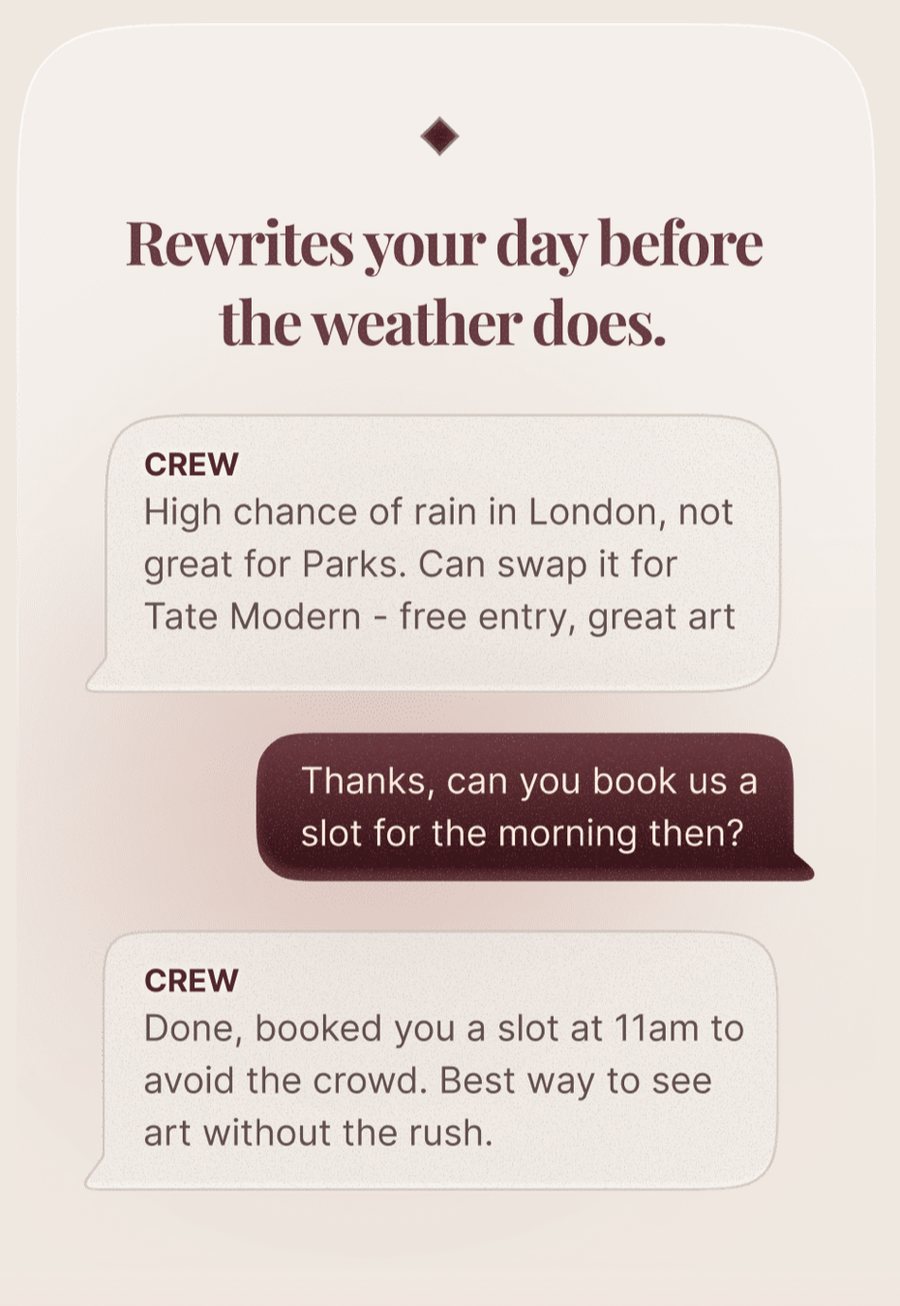
A few parts of a plan move on their own. The gate. The departure time. A connection gone too tight. The cab that no longer meets it. Rain over an activity booked outdoors. Nobody checks them until it is too late.
Here is how it would work:
- The plan is a record. Every leg and every day has a time against it.
- The app watches the moving parts against it, all day, unasked.
- When one breaks the plan, the app finds the fix and writes the message, and a person checks whatever needs checking.
- The traveller hears it from CREW first.
This needs one thing, and it is narrower than it sounds. The record plainly exists — you cannot tell somebody their terminal has changed without holding their terminal. The question is whether anything reads it when nobody has asked, and that I cannot see from outside. If something does, the rest is assembly. If nothing does, building that watcher is the first task, and worth doing on its own.
You cannot move someone’s Tuesday afternoon unless you know what was in their Tuesday afternoon. The app knows. What it does not do is look.
The Build: What to Do, and in What Order
The aim is to spend those rare people only where judgement is needed. Messages sort into three tiers.
- Most are not judgement calls. They are facts the source itself asserts — the airline says the gate has moved. Relaying those is not a decision, and they go out without anyone touching them.
- Next are the ones the app works out: the connecting flight is now too tight, the cab no longer meets the plane. The app finds the alternative and drafts the message, and a concierge approves it rather than writing it.
- Everything else goes to someone who decides.
Which is why the line between the first two sits where it does. A fact can go out on its own. An inference waits for a person, because an alert about a connection that was never at risk costs more than saying nothing.
The next change is smaller and worth more. One message is not one job. A couple wants a day at a vineyard outside the city, and inside that sentence sit seven questions, six of which already have answers. Today all seven wait for the same person. When a concierge solves the one that does not, it gets written down against that place.
The booking was never the output. The output was a fact nobody had recorded.
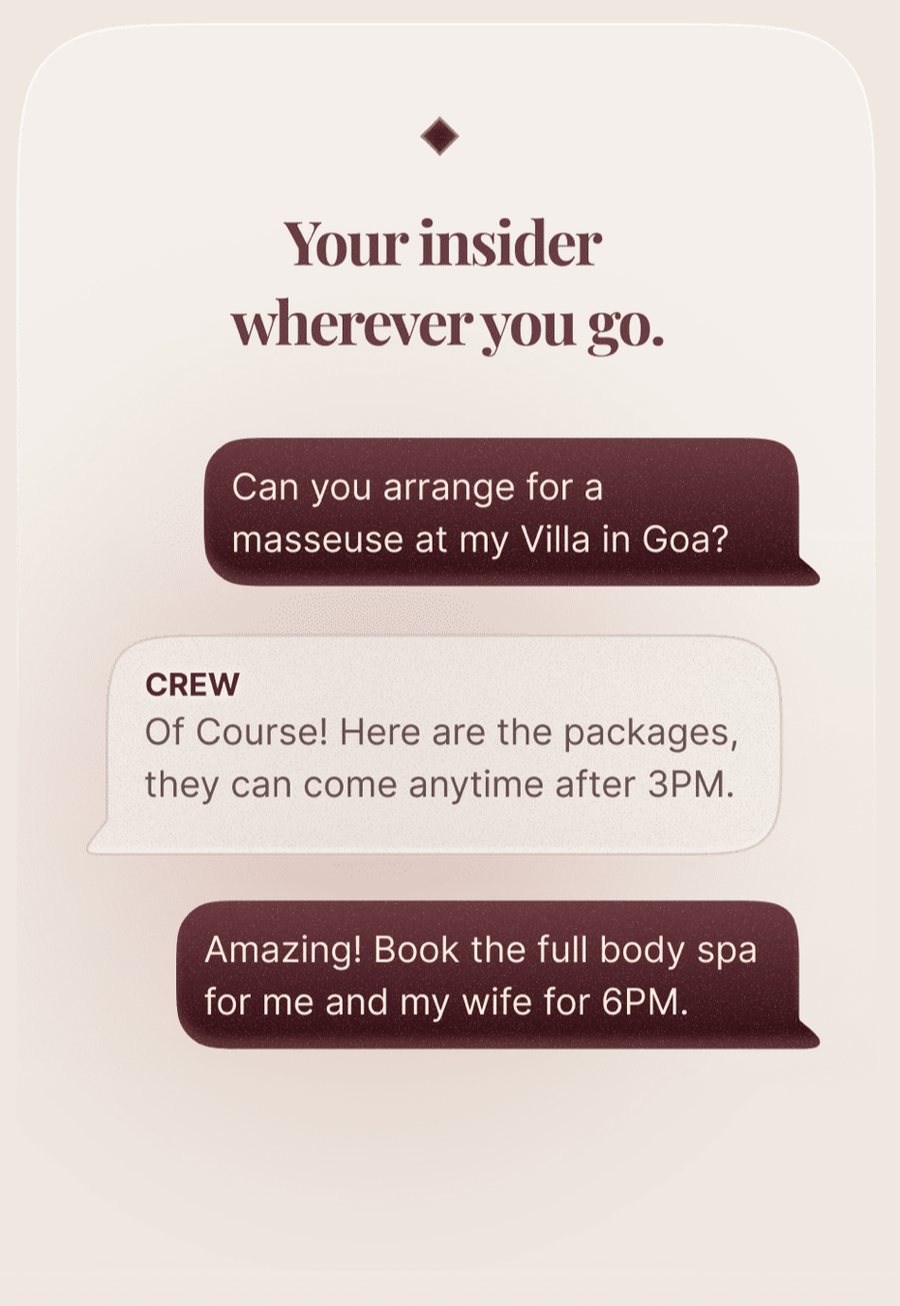
Some of this should stay human. A masseuse at a villa in Goa is not an API. Nobody has automated being the person who is answerable once something has gone wrong.
Measurement: How You Would Know It Worked
Four numbers to watch, and one test that would prove me wrong.
- The let-go rate. The share of trips where the customer never had to hold on: no confirmation checked, no reply chased, no query about a bill that was supposed to be settled.
- Cost to serve. The human minutes one trip consumes. Headcount alone can buy the first number, so it only means something with this one beside it. Let-go rate up and minutes down is the service working. Let-go rate up and minutes flat is quality CREW cannot afford to keep.
- Reuse of the file. The share of requests answered from a fact already recorded rather than worked out again. If the file is never reused, the seventh question was not worth writing down.
- Wrong-message rate. The share of auto-sent messages a traveller or a concierge later contradicts — the guardrail on the first tier. A service that cries wolf has spent the trust it was meant to protect.
- The test that would prove me wrong. Compare members who lean on the service against those who only book. If both come back at the same rate, the accompaniment was never the advantage, and the honest move is to unbundle it.
What Is Worth Protecting
Almost every travel product competes on the same two things. Price, or inventory. Cheaper, or more of it. CREW competes on attention, which is harder to buy and much harder to fake.
The terminal message. The afternoon rewritten before the rain arrives. The masseuse at a villa in Goa. None of it is a feature in the usual sense. It is one thing: somebody paying attention on your behalf, without being asked.
Attention is the scarce thing here, and you cannot hire your way to more of it. Every minute a concierge spends typing out a gate change is a minute not spent on the supplier who will not pick up the phone. Give the gate change to the app and the person is still there, on the call only a person can make. That call is what the minutes are freed for. CREW brought a guide in Hoi An into its network, at the moment its own people are the thing it can least afford more of. The gate change is what you automate so the concierge is free for the call. And the vineyard that would not answer in June is a phone number in the file by August.
Get that right and the ceiling moves. The same people cover more trips. The service does not thin out as it grows. And someone who has never flown this route still lands knowing which train to take.
That is a rare thing to have built, and rarer still inside a company that grew on the opposite instinct — speed, volume, riders who are interchangeable by design. It is worth protecting.