← All work
● DeployedConsumer AI

Savio

An AI companion for the one question budget apps never answer: can I afford this, right now? It reasons over your real income, commitments and goals.

Platform
React + Supabase web app
Stage
Deployed, actively maintained
Method
Primary research, then built and tested against itself
Trade-offs

A warning at the checkout. Location nudging. Telling you what to invest in. All six, and why ↓

ProblemMoney apps tell you where your salary went. None answer the question you actually have. Can I afford this, right now? Will it break something I've already promised? So people guess. Guessing is how a month quietly goes wrong.
DecisionCode works out every number. The AI writes the sentence you actually read. In testing it called 8 of 9 purchases regrets when the real answer was 7 of 8, so rather than add a checker on top I took the AI out of that job.
EvidencePrimary research, 10 interviews and 31 survey responses across four countries. 45% do the maths in their head with no tool at the moment of decision. 71% wanted to see what a purchase does to their savings, the strongest signal in the study. Four people had already invented their own safety rule.
OutcomeA live app that would rather stay quiet than show a number it can't stand behind. Trust built in, not promised in small print.
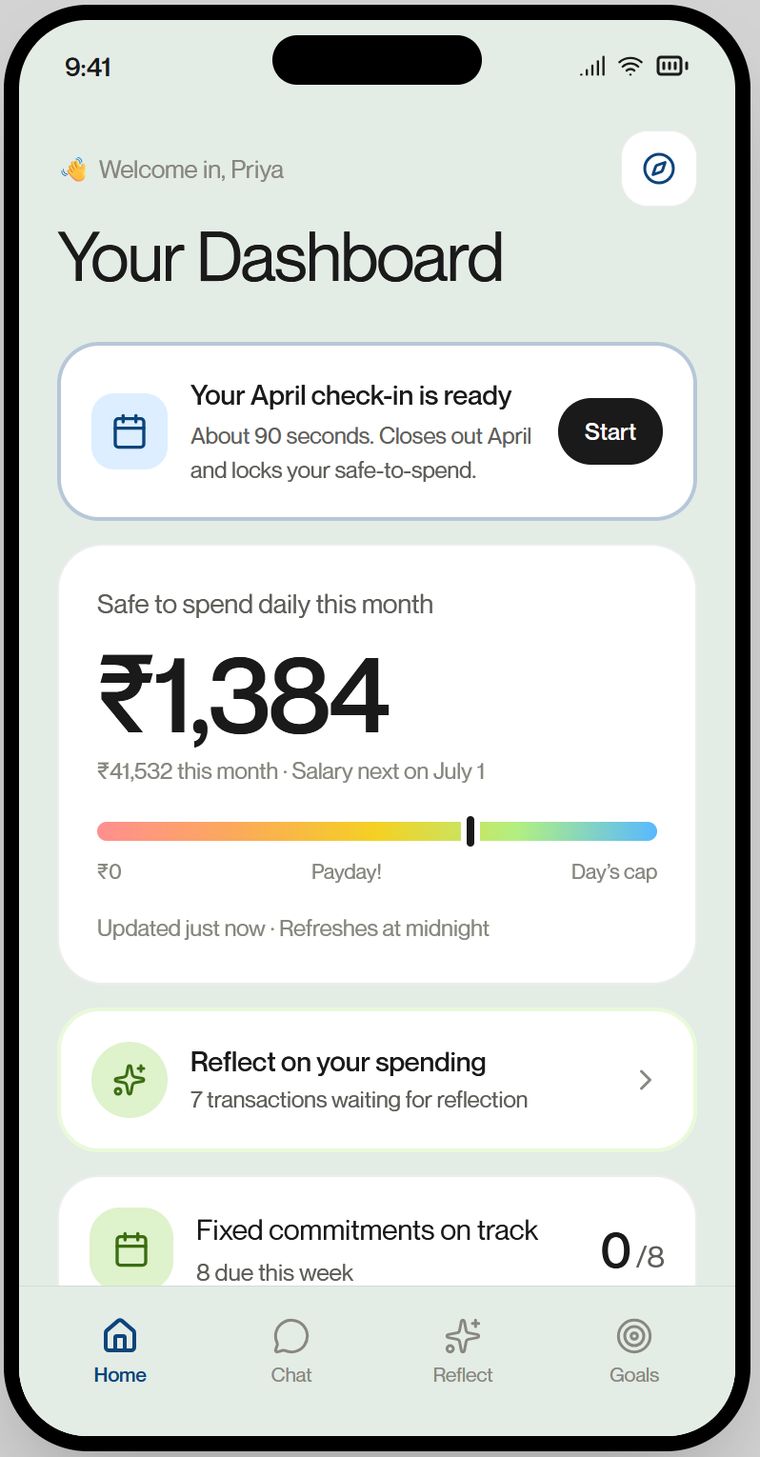
Savio's home screen: an April check-in prompt, "Safe to spend daily this month" showing ₹1,384 with the month total and next salary date, a reflection prompt, and fixed commitments on track.
The home screen. One number, and what it is made of.
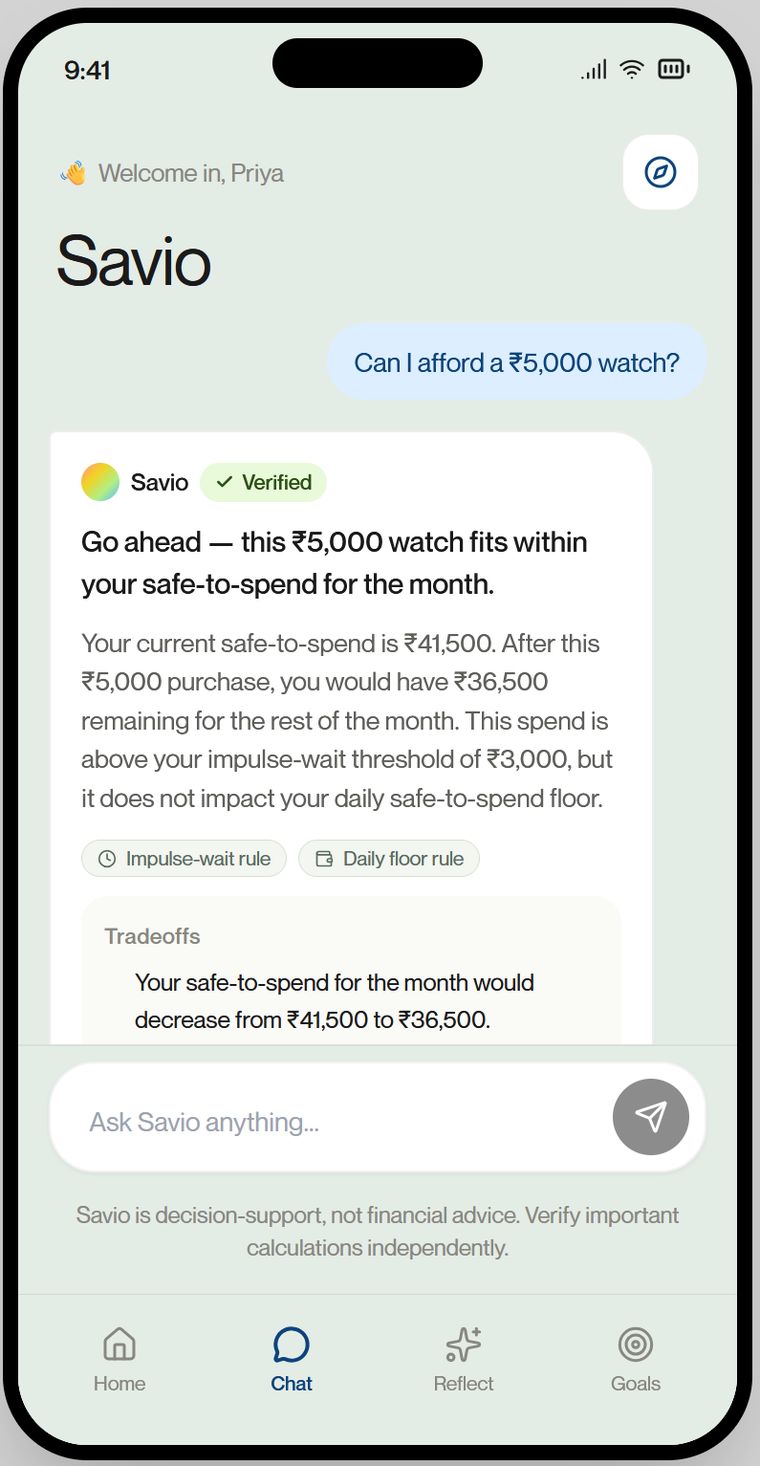
Savio's chat answering "Can I afford a ₹5,000 watch?" — a Verified badge, the verdict, the working, and chips naming the impulse-wait and daily-floor rules it used.
It answers, shows the maths, and names the rule it used.
Savio

How I picked the moment

Six interviews said financial decisions are slow burns. The prioritisation scored that finding last. I read the frequency as wrong and built for it anyway.

What I readFinancial decisions are slow burns, not checkout moments. Five of six interviews. One person deliberated on a phone for a year.
What the room didScored it last of four, 18 out of 125, as a quarterly problem.
What I disagreed withNot the problem. The frequency. The window is long, but its book-ends are monthly.
What I ruled outThe checkout. Nobody opens an app in a fitting room, and an app cannot see that moment coming.
What I pickedPayday. The day a bonus arrives. The days after a purchase, when you know whether it was worth it.
What I lockedNo mid-purchase interventions, ever. The first thing I fixed and the hardest to hold.
When Savio speaks, across one month Savio speaks on payday, when a windfall arrives, and a few days after a purchase. It never speaks at the checkout, which is the moment every other budgeting app targets. 1ST Payday Already thinking about the month Checkout Silent, always A few days after Windfall Before it goes THE ONE IT SKIPS A purchase that matters is made in ninety seconds. Nobody opens an app inside them.
Every other budgeting app aims at the checkout. That is the moment nobody is listening, and the one Savio was built to skip.

How it works

It waits for a moment you are already reflective, grounds every figure in your own data, and quotes back a rule you set yourself.

Picks its momentNot a popup at checkout, when you have already decided. It steps in when salary lands, when a windfall arrives, and a few days after you bought something.
Explains, groundedCode produces the numbers. The model turns them into something you would act on, drawing only on what is really yours. A correct number nobody reads changes nothing.
Quotes your ruleNot “this is over budget”, but “over the ₹3,000 impulse-wait limit you set”. A rule you wrote yourself is a rule you will accept.
The Savio chat screen answering “Can I afford a ₹5,000 watch?” with a verdict, the safe-to-spend maths behind it, and the named rules it used.
The answer, the working, and the rule it used, in one screen.

Trade-offs

Six calls. Each gave something up for something worth more.

Timing over presenceThe checkout was the original idea. A purchase takes ninety seconds and nobody opens an app inside one, so I speak at payday, a windfall, and the days after.
Voice over vigilance“You’re near a Myntra. You’ve regretted four of four purchases there.” Accurate, and it turns a companion into something that watches you.
Licence over leverageNaming a fund is regulated advice and needs a licence I do not have. Blocked in code rather than in the prompt, so it cannot be talked around.
One job over the next oneTax regimes and 80C instruments are a chartered accountant’s job. Adjacent, tempting, and the same filter catches it.
One question over a dashboardStocks, funds and deposits together is a different product with different competitors. I gave up breadth to answer one thing properly.
One model over half-fitting twoJoint money has its own problems: who consents, whose goal is whose. Better to serve one person than half-serve two.
Savio’s Reflect screen showing a worth-it versus regret trend over six months and a per-merchant breakdown of regret rates.
These patterns are computed from labelled purchases. The model’s job is to describe them, never to count them.

What it costs to run, and how it could pay

A verdict costs $0.0043 to produce. An active user costs about ₹4 a month. Cost is not what limits this product. A forced model migration and three regulatory boundaries are.

Calls the modelThree of five functions. The monthly ritual and the windfall allocation run in code and cost nothing.
Per verdict6,800 tokens in, 900 out. $0.0043, about a third of a rupee.
Biggest leverThe system prompt is 61% of every input and never changes. Cached at a tenth of the rate, a verdict drops to $0.0032.
Per userAbout ten model calls a month. $0.041, or ₹3.6.
AssumptionTen calls is derived, not measured. One ritual follow-up, two reflections, five considered purchases. The five is the number to argue with.
DeadlineGemini 2.5 is deprecated from October 2026 and repriced after January 2027. The deadline is January.
The choiceThree migration targets, six times apart. 3.1 Flash-Lite is 40% cheaper than today. 3.5 Flash-Lite is the same. 3.5 Flash is four times more. Move to a Lite tier and prove quality on the existing tests. Cost is not a reason to move up a tier. A failed grounding would be.
The real workThe model ID is already an environment variable, so the swap is config. But Gemini 3 needs thought signatures carried between turns, and Savio replays six. That is the change that takes time.
RevenueThree rejections close the usual doors. Naming investments needs a SEBI licence. Tax needs a chartered accountant. Real accounts need Account Aggregator and an RBI-registered partner. A subscription is what is left.
The real capAt ₹4 of cost, price is not the constraint. Until account connectivity lands you type your own numbers in, and a product you maintain by hand is one you stop paying for.
Cost of one Savio verdict, broken down Input is 6,800 tokens: 4,175 of static system prompt, 1,800 of conversation history, 825 of financial context. At $0.30 per million that is $0.0020. Output is 900 tokens at $2.50 per million, or $0.0023. One verdict costs $0.0043. About ten model calls a month brings a user to $0.041. INPUT 6,800 tokens System prompt 4,175 · 61% History, 6 turns 1,800 Her financial data 825 Identical on every call. Cacheable at 10%. × $0.30 / 1M $0.0020 OUTPUT 900 tokens response + reasoning × $2.50 / 1M $0.0023 ONE VERDICT $0.0043 about a third of a rupee × ~10 model calls a month PER ACTIVE USER $0.041 ₹3.6 a month ON 3.5 FLASH INSTEAD $0.171 The same product, four times the bill.
One verdict, priced. The system prompt is the same text on every call, which is what makes caching the biggest lever here. Not all ten monthly calls are full verdicts — two are the cheaper reflection synthesis.

What it cannot be yet

Nobody manages real money with it, and that is a legal boundary rather than an unfinished feature.

Who uses itSavio runs on Priya, a seeded user with six months of history.
Why not real moneyTouching real accounts in India means the Account Aggregator framework and RBI-registered partners. A months-long integration with obligations I cannot take on alone.
What beta foundA handful of people used the demo and found what I could not. One could not work out how to leave. Another never found the Reflect tab. The home screen said “safe to spend today” above a figure that was the whole month’s. Five real fixes.
The open questionWhether any of this changes what somebody does with their money. Beta testers on a demo are spending nothing. That needs users I am not allowed to have yet.