← All work
● In useChrome extension

FitCheck

A calculator, not a guess. It reads the size chart already on the page and works out whether the size will actually fit.

Chrome, Edge, Brave or any Chromium browser. The side panel it runs in does not exist in Firefox or Safari.

Platform
Chrome extension
Stage
Shipped, in use
Method
Built, shipped, calibrated on my own returns
Trade-offs

A Myntra-only feature. 3D scanning and virtual try-on. Asking you for your measurements. All seven, and why ↓

ProblemFree returns are why people in India buy clothes online. You can't tell if something fits, so you order it and send it back. A quarter to a third of orders come back. Size is the biggest reason. Each one costs the retailer shipping both ways, handling, and often a garment it can't sell again. The chart that would prevent it sits on the page, unread.
DecisionBuild a calculator, not a guess. It compares the fit a garment was designed for with the fit you'd actually get. The chart is already exact, so arithmetic is the right tool here.
EvidenceTen installs. 70% were still using it a week later. Nobody uninstalled it. And it refuses to answer when the size chart is missing or unreadable — eight cases where it says so instead of guessing.
OutcomeIt caught a real sizing mistake of mine. One that had already cost a return and an exchange. Every verdict can be checked against the store's own chart.
The FitCheck side panel on a Myntra jeans page: verdict "34, loose at waist", a red "Not recommended" chip, a tinted silhouette pinned "Hip loose by 4.0 inches", the per-axis reasoning, and a size selector marking 30 as the recommendation.
A size it turns down, with the axis that fails and where to go instead.
The FitCheck side panel: verdict "L, slightly long", an amber "May work for you" chip, a callout reading "You previously bought size M. The fit math now recommends L", a tinted silhouette with per-axis pins, and the reasoning for each axis.
Live on Myntra. It disagrees with your last purchase, and says why.
FitCheck
Waist measurement 30 in

The label said 30. So did my waist.

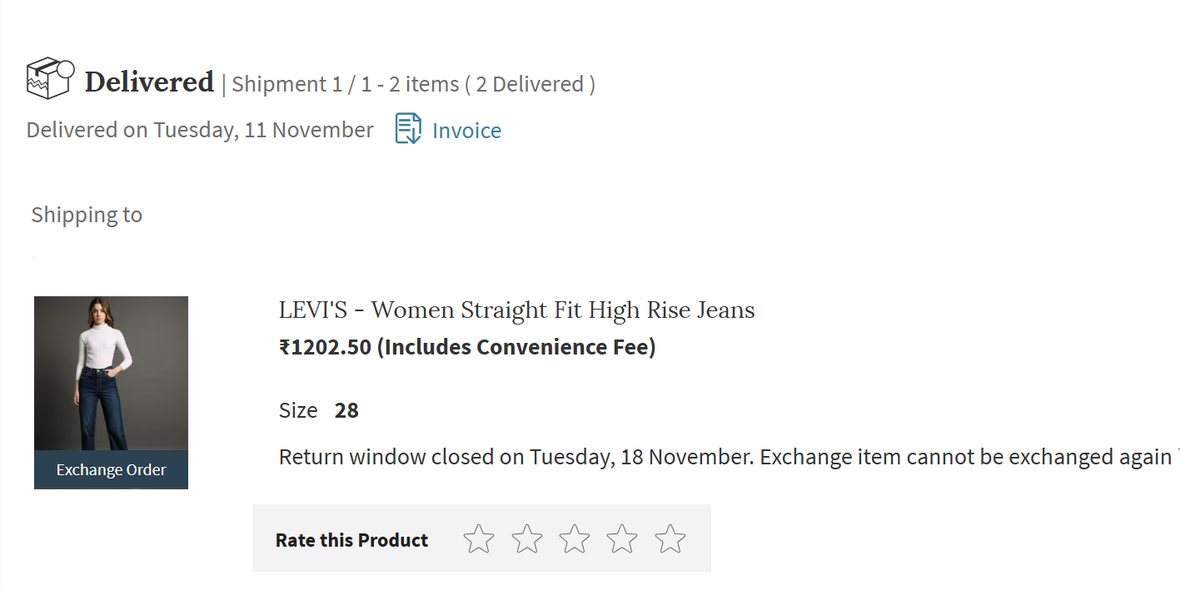
I ordered Levi’s jeans in size 30. My waist is 30 inches. They arrived too loose.

I sent them back and exchanged them for a 28. That should not have been possible.

Then I read the size chart on the page I had just bought from. On that cut, a size 28 is made for a 30-inch waist. The label was never a measurement. It was a name.

The chart had been sitting on that page the whole time I was ordering the wrong thing. Three shipments, one out, one back, one out again, for a pair of jeans whose correct size was published two scrolls down.

Not long after, Myntra, AJIO, H&M and Westside were all running sales at once and I had a tab open on each. I shop for clothes on a laptop, because a bigger screen shows me more of what I am about to buy. That preference is the only reason I noticed.

Across four tabs, the same letter meant four different bodies. An M on one site was not the M on another. Myntra and AJIO were worse, because they are aggregators. Every brand inside them ships its own chart.

I am an XS in some places. An S in most. An M in a few. There is no version of me that is one size.

And every one of those pages already had the chart on it. The information was never missing. It just asked me to do arithmetic across four tabs, in my head, while a sale timer ran.

So the chart was never the problem. Trusting it was.

How it works

It reads the chart the shop already published, works out your fit from it, and can build your profile from something you already own.

Reads the pageEach of the three stores publishes its chart differently, so there is a small reader for each one. They all hand back the same set of numbers.
Does the mathsYour body against what the garment was actually cut for. Two inches of room means slim. Eight means oversized.
Uses what you ownOn a past order it knows the size you bought, and can build your profile from it. So you never have to measure yourself.
Body measurement against garment measurement A size chart gives the body a size is cut for. The garment measured flat is larger. The difference is ease: about two inches reads as slim, about eight inches reads as oversized. Both garments target the same 36-inch body. THE BODY THE SIZE IS CUT FOR 36 in THE SAME SIZE, MEASURED FLAT 38 in +2 in · slim 44 in +8 in · oversized Bars start at 30 in. Ease drawn to the same scale. THE GAP IS THE DESIGN Both target the same 36-inch body. One is cut close. One is meant to hang. Miss it and an oversized tee reads as too tight.
The chart alone cannot tell you how something will fit. The distance between the body and the garment is what the designer decided, and it is the whole product.

Trade-offs

Seven scope calls, none about difficulty. Each gave something up for something worth more.

Reach over depthThe first build was a feature inside Myntra. You cannot ship inside their page without being them — and the problem is not inside one shop. Four shops disagree about what an M is.
Trust over accuracy3D and try-on both chase accuracy. The chart is already exact, so accuracy was never the gap. Trust was. Promise a perfect fit and you get to be wrong once.
Completion over precisionBust, waist and hip is the precise input, and the point where people abandon the form. Everyone knows which shirt fits them, so it asks that.
The constraint over the retailerWestside publishes its chart as an image. Reading it needed a network call, and the extension makes none. I kept the constraint and dropped the retailer.
Useful over correctReal inseam is about 0.45 of height. I use 0.3, because Levi’s lists 32 inches for every waist from 28 to 40. The correct answer would flag jeans sold long on purpose.
Silence over a confident answerShort a measurement, it says it cannot tell. Six times in twenty-one. A confident answer with nothing behind it costs more trust than no answer.
Reach I have over reach I wantDesktop only, about 40% of fashion traffic. It exists to validate one thing: whether a fit verdict changes what people buy, on the surface I can reach without permission.

The same page, with FitCheck on it

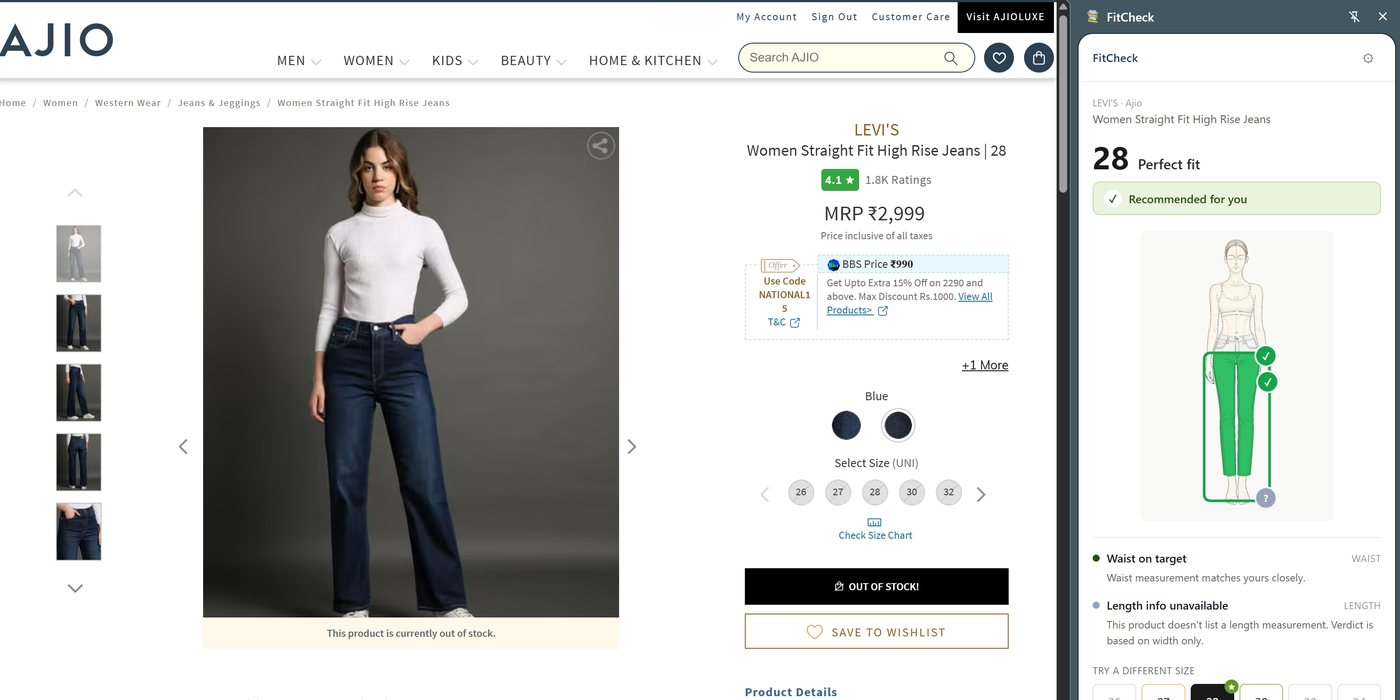
The jeans from the top of this page, and what the extension says about them now.

What the chart saidThat cut puts the body waist for size 28 at 30 inches. The label was misleading. The chart was accurate all along.
What FitCheck says28, on that page, before the order. One shipment instead of three.
Why it countsIt is one case, not a study. But it is a case where the answer was already published and I still got it wrong, which is the whole argument for the product.
The FitCheck panel on the AJIO Levi’s jeans page recommending size 28, with the waist marked on target and a green silhouette.
FitCheck picking 28 on the live product page.
AJIO order history showing the same Levi’s jeans delivered in size 28, marked as an exchange order.
And the order it replaced. A 30, exchanged for a 28.

What is missing, and what closes it

A working engine, one case where it would have saved a return, and nowhere near the users needed to know if it holds. Each gap below has the move that closes it.

Sample sizeTen installs, seven retained at a week, zero uninstalls. Logged by hand, because there is no instrumentation in this. Ten is a signal, not evidence.
The metric to instrumentOverride rate — how often a shown size is rejected for another. The cleanest trust signal there is, and the extension already sits where it happens.
Coverage, not accuracySix refusals in twenty-one attempts. Not failures: the chart was short a measurement. Coverage is the constraint, and every refusal names the gap it hit.
Who it does not serveTwo body blocks, male and female, because retailers publish charts that way. A measurements-first model is the replacement, and the one case worth the drop-off.
The north-star I cannot reachVerdict-to-purchase — of those shown a size, how many buy it. It sits inside the retailer’s checkout. That is the case for shipping on their page.
A Myntra jacket page beside the FitCheck panel reading “Can’t compute a fit for this product”, explaining that the size chart is missing a measurement.
A refusal, on Myntra, which has the cleanest data of the three. The size chart is right there on the page. It is just short a measurement, and the panel says so rather than guessing.